


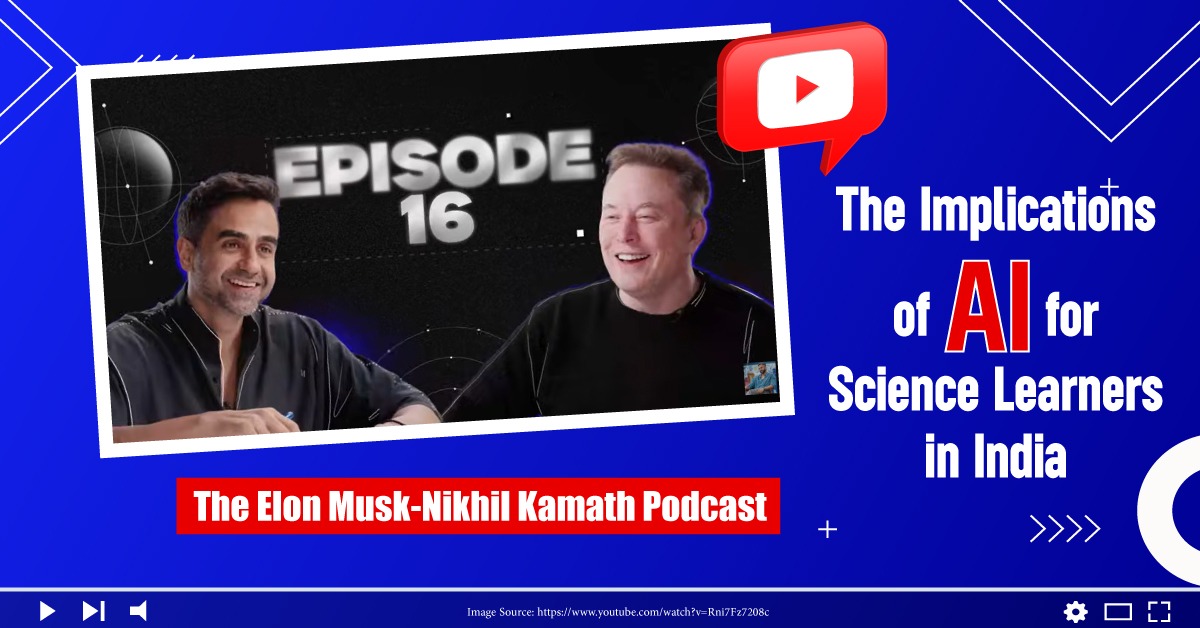
The typical tech talk took a turn when billionaire entrepreneur Nikhil Kamath joined Elon Musk on his “People by WTF” podcast in late November 2025. For two hours, the world’s wealthiest individual discussed topics ranging from artificial intelligence and robotics to work, consciousness, and the future of mankind. Importantly for young Indians—primarily science students—the episode offered a glimpse into how AI will transform careers, education, and prospects over the coming decade.
The Major Forecast: Employment turns voluntary
Musk confidently forecasted that developments in AI and robotics will reach a point where employment becomes redundant, and work will transform into a leisure activity driven by automation. He further mentioned that he is highly certain that, given the speed of advancement within 10 to 20 years, individuals will obtain anything they desire without the need for conventional labor. For the science students in India contemplating their paths today, this prospect is both thrilling and daunting.
What does that imply? Musk isn’t suggesting that people will be idle. Rather, he envisions a future where individuals engage in work out of desire, not necessity. Disciplines, like physics, chemistry, biology, and mathematics,won’t disappear; they will evolve. Future scientists, engineers, and researchers will pose inquiries: not just “what is possible?” but also “which challenges truly captivate me?”
Three Pillars of Safe AI
During the conversation, Musk emphasized that AI tools should aim for truth rather than spreading falsehoods; among the top three priorities for AI, Musk named truth, beauty, and curiosity. This represents a viewpoint that will significantly influence science education in India.
Typically, Indian students are taught to memorize facts and formulas. Musk envisions a different approach. If AI is capable of processing data more rapidly than any person, then our worth must originate elsewhere: posing sharper questions, recognizing significant challenges, and maintaining intellectual curiosity. Science students must cultivate thinking abilities that enable them to distinguish between fact and falsehood, especially in an era dominated by AI-generated material.
Musk additionally cautioned that compelling AI to accept untruths might cause it to “go insane” and arrive at outcomes. This highlights the duty involved in developing such technologies for students pursuing fields like machine learning, data science, or AI research.
India’s Increasing Importance to the Global Technology Ecosystem
The captivating part of this podcast was when Musk disclosed that his partner Shivon Zilis has Indian heritage and that one of his sons carries the middle name Sekhar, inspired by Indian-American Nobel Prize winner Subrahmanyan Chandrasekhar. This was more than a piece of trivia; it highlighted the influence Indian scientific expertise has had on personal life.
From a standpoint, Musk addressed immigration and the skilled workforce, strongly emphasizing the significance of Indian expertise in the United States. This serves as both a comfort and a call to action for science students in India: the worldwide need for engineers, coders, and scientists remains substantial. However, the crucial issue is whether you are equipped with the skills in a world dominated by AI.
Also Read: How AI Is Transforming Coaching Institutes
Rethinking Science Education for the AI Age
Conventional science education focuses primarily on studying from books and preparing for tests. Many years have been devoted to understanding topics that artificial intelligence can now clarify in an efficient way, to put it simply. This is precisely the point highlighted by the Musk-Kamath discussion—the method needs to be transformed.
Qualities essential for scientists:
- Disciplinary intellects: Physics students must be familiar with machine learning. Biology students should understand modeling. Chemistry students need to comprehend data science. The lines dividing each field are becoming more unclear; AI accelerates this development.
- Problem recognition: AI excels at addressing specified problems. The crucial expertise involves determining which problems merit attention. Are climate change, health care access, and sustainable energy the challenges that require judgment to set priorities?
- Ethical Decision Makers: As Musk pointed out, developing AI that seeks truth demands incorporating values. Science is never value-free. Students must be educated in ethics, alongside equations.
The Energy Revolution and Scientific Opportunity
Musk previously emphasized that the advancement of civilization relies on the management and effective use of energy spanning from planetary to stellar to levels as described by the Kardashev scale. This presents an opportunity for students specializing in physics and engineering. India is transitioning to renewables from fuels, nuclear energy, and potentially fusion, generating a need for scientists with profound knowledge of these technologies.
Solar energy, energy storage, and electricity network control are challenges that extend beyond technology, requiring insight from physics, materials science, computational simulation, and holistic approaches. Artificial intelligence will assist in addressing these issues. Human researchers need to formulate the problems and confirm the outcomes.
What Actions Are Recommended for Science Students at This Point?
For today’s science learners, the message is quite clear: Initially, never abandon sciences; physics, chemistry, biology, and mathematics are the foundation. AI technologies depend on these foundations. However, combine your essentials with abilities, master at least Python, grasp fundamental ideas of machine learning, and become proficient in handling data. Next, nurture an inquisitiveness. Musk mentioned that AI “ought to be more fascinated by the world. Humanity is more captivating than machines.” Students who engage with science through curiosity consistently question “why “. Linking diverse concepts will stay important regardless of AI’s advancements. Third, cultivate communication abilities. Although AI handles computations and data analysis independently, humans need to excel at articulating intricate concepts and collaborating across disciplines to convey their ideas to wider audiences. Science does not function in isolation. The Broad View: Meaning in a World Driven by Automation. One of the questions raised in this podcast concerns purpose: If labor is no longer necessary and AI supplies material wealth, what then imparts significance to life? In this context, the science students recognize that Science has perpetually been more than just climbing the career ladder; it is fundamentally about comprehending our cosmos, or enhancing human welfare, and pushing the limits of understanding. Musk imagined this future of plenty as a time when individuals engage in activities they genuinely desire. For enthusiasts of science, this might represent freedom: investigating issues purely out of curiosity rather than for job stability or financial gain.
Conclusion
The Change Must Be Accepted. The Elon Musk-Nikhil Kamath podcast was more than entertainment or idolization. For science students in India, it served as a wake-up alert. The coming 10 to 20 years will bring changes to how we work, study, and generate value. AI may take over tasks currently performed by humans, yet at the same time, it will generate chances for those who adjust. Now is the moment for Indian science education to shift away from learning and advance towards creativity, from isolated subjects to holistic thinking, and from just technical skill to ethical leadership. Success will not always belong to the ranking students but to those who stay inquisitive, flexible, and dedicated to the truth. As Musk’s dream may be far away, for the student starting university today, it will shape their working life. It is not a question of whether AI will change science but whether you will be prepared to use such tools responsibly and imaginatively to solve problems that matter. And for the foreseeable future, the edge will go to those who view AI not as a competitor but rather as an augmenter of human curiosity and prowess.
: I’m Aadvik Chaturvedi, a CSE student at DTU (2024–28 batch) and a Full-Stack & AI Developer who loves building things that blend creativity with cutting-edge technology. From MERN stack development to machine learning and LLM-based projects, I enjoy turning complex ideas into practical, user-friendly solutions.
As someone who has gone through the journey from JEE preparation to earning a seat at DTU, I understand the challenges, pressure, and dedication this path demands. Today, I try to give back by sharing insights, strategies, and real experiences that can help JEE aspirants stay focused, motivated, and informed.
Through my blog, I write about tech, college life, projects, and the mindset that helps you grow beyond the exam—because JEE is just the beginning.
If you’re a student aiming for top engineering colleges or someone curious about life at DTU, you’re in the right place. Let’s learn and grow together.
: I’m Aadvik Chaturvedi, a CSE student at DTU (2024–28 batch) and a Full-Stack & AI Developer who loves building things that blend creativity with cutting-edge technology. From MERN stack development to machine learning and LLM-based projects, I enjoy turning complex ideas into practical, user-friendly solutions. As someone who has gone through the journey from JEE preparation to earning a seat at DTU, I understand the challenges, pressure, and dedication this path demands. Today, I try to give back by sharing insights, strategies, and real experiences that can help JEE aspirants stay focused, motivated, and informed. Through my blog, I write about tech, college life, projects, and the mindset that helps you grow beyond the exam—because JEE is just the beginning. If you’re a student aiming for top engineering colleges or someone curious about life at DTU, you’re in the right place. Let’s learn and grow together.
One reply on “The Elon Musk-Nikhil Kamath Podcast: The Implications of AI for Science Learners in India”
kapil December 16, 2025 at 12:27 pm
Brilliant coverage